Table of Contents
- Homemade Custard vs Grocery Store: What Actually Matters
- Taste and Flavor Differences Between Homemade and Store-Bought Custard
- Store-Bought Custard Ingredients and What’s Really in the Container
- Texture, Creaminess, and Consistency: Homemade Versus Store-Bought
- Cost Per Serving: Breaking Down the Real Budget Impact
- How to Thicken Store-Bought Custard and Other Fixes
- Homemade Custard Storage Time and Food Safety
- Frozen Custard vs Ice Cream: How They Compare
- Making Custard from Scratch: Time, Effort, and Why It Matters
- Frequently Asked Questions
Last Updated: October 21, 2026
Homemade Custard vs Grocery Store: What Actually Matters
The real question is which option works for what you need.
The homemade custard vs grocery store choice comes down to five things: taste, texture, ingredients, cost, and convenience. Most people focus on one factor and miss the others.
Here are the actual tradeoffs so you can pick what fits your situation.
Taste and Flavor Differences Between Homemade and Store-Bought Custard
Homemade custard tastes richer and more complex. You control every ingredient, so the vanilla flavor is stronger, the egg richness comes through, and there’s no artificial aftertaste. Store-bought custard often tastes flatter from sitting in a container for days or weeks.
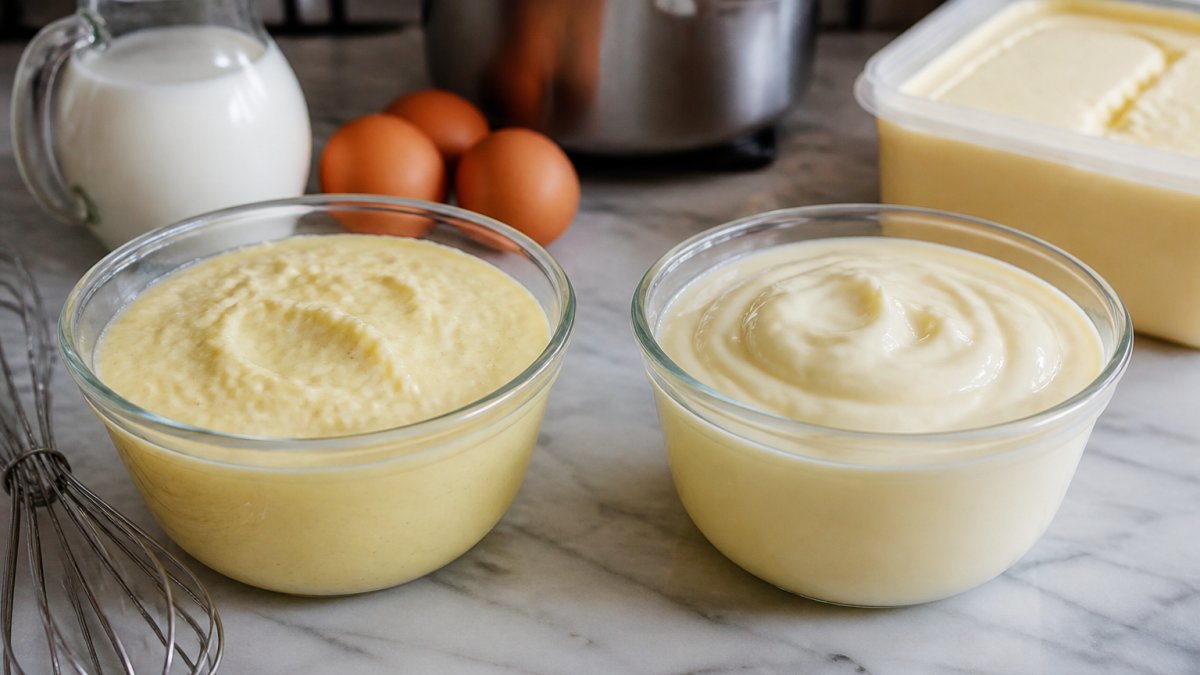
Side by side, homemade custard tastes fresh and creamy right away, while store-bought tastes more uniform and less distinctive.
Store-bought custard is made to last, so stabilizers and preservatives keep the flavor consistent but somewhat muted.
Here’s what matters for your decision: if you’re serving custard as a dessert where people will taste it on its own, homemade wins on flavor.
Store-Bought Custard Ingredients and What’s Really in the Container
Store-bought custard typically contains milk, cream, egg yolks, sugar, cornflour (or cornstarch), and vanilla, plus additives most homemade recipes skip: guar gum, locust bean gum, sodium phosphate, or carrageenan.
That doesn’t mean it’s bad, these are FDA-approved substances used safely in thousands of products, but they do change the texture and how the custard behaves.
Homemade custard uses just milk, cream, egg yolks, sugar, cornflour, and vanilla, with no additives.
If you have allergies or prefer to know exactly what you’re eating, homemade custard gives you that control. If you want custard that stays smooth and doesn’t separate, store-bought’s additives actually help.
Texture, Creaminess, and Consistency: Homemade Versus Store-Bought
Homemade custard has a silky smooth texture when made correctly: thick but pourable, coating your spoon evenly.
Store-bought custard feels creamier because of the stabilizers. It holds its texture better, doesn’t break easily, and stays consistent whether it’s been in your fridge three days or three weeks.
The real difference: homemade custard requires skill. If you don’t whisk it properly or overheat it, you get lumps or a broken custard. Store-bought custard is forgiving and reheats without worry.
For tarts and pastries, store-bought custard’s consistency is often easier to work with because it doesn’t break. For serving as a dessert on its own, homemade custard’s silky texture is hard to beat.
Cost Per Serving: Breaking Down the Real Budget Impact
Most comparisons of homemade custard vs grocery store custard wave at cost without doing the math.
What a homemade batch actually costs
A standard homemade custard batch starts with 2 cups whole milk, 1 cup heavy cream, 4 large egg yolks, 1/2 cup granulated sugar, 2 tablespoons cornstarch, and 1 teaspoon vanilla extract. At typical supermarket prices:
- Whole milk, 1/2 gallon: about $2.50 to $3.50, so 2 cups runs roughly $0.60 to $0.90
- Heavy cream, 1 pint: about $4.00 to $5.50, so 1 cup runs roughly $2.00 to $2.75
- Large eggs, dozen: about $3.00 to $5.00, so 4 yolks run roughly $1.00 to $1.65 (and you keep the whites for another use)
- Granulated sugar, 4 lb bag: about $3.50, so 1/2 cup runs roughly $0.15
- Cornstarch, 16 oz: about $2.50, so 2 tablespoons runs roughly $0.10
- Vanilla extract, 2 oz: about $5.00 to $8.00, so 1 teaspoon runs roughly $0.40 to $0.65
That puts a from-scratch batch at roughly $4.25 to $6.20 for about 4 to 6 half-cup servings, or about $0.70 to $1.55 per serving. Using whole eggs instead of yolks and skipping the cream in favor of all milk pushes the low end closer to $0.50 per serving.
What grocery store custard actually costs
Ready-made chilled custard is usually sold in 16 oz to 32 oz tubs. At typical prices:
- A 16 oz tub of refrigerated vanilla custard runs about $3.50 to $5.50, or roughly $0.22 to $0.34 per ounce
- A 32 oz tub runs about $6.00 to $9.00, or roughly $0.19 to $0.28 per ounce
- Shelf-stable custard in aseptic cartons often runs $2.50 to $4.00 for 32 oz, or roughly $0.08 to $0.13 per ounce
- Custard powder runs about $3.00 to $5.00 for a 10 oz to 12 oz can, and one can makes many batches when combined with milk and sugar you buy separately
At a half-cup serving (4 oz), that works out to roughly $0.75 to $1.35 per serving for chilled tub custard and roughly $0.30 to $0.50 per serving for shelf-stable custard before you add the milk.
The honest comparison
On ingredient cost alone, homemade custard and mid-priced chilled grocery custard land in a similar range. The real difference is time and risk: homemade takes 30 to 45 minutes, and a failed batch wastes the full ingredient cost. Shelf-stable custard and custard powder are cheapest per serving, but you trade freshness and control for that price.
| Factor | Homemade (egg custard) | Chilled grocery custard | Shelf-stable custard | Custard powder |
|---|---|---|---|---|
| Typical package price | N/A (batch) | $3.50-$9.00 per 16-32 oz tub | $2.50-$4.00 per 32 oz carton | $3.00-$5.00 per 10-12 oz can |
| Cost per half-cup serving | ~$0.70-$1.55 | ~$0.75-$1.35 | ~$0.30-$0.50 plus milk | Low, plus milk and sugar |
| Active time | 15 min (30-45 total) | None | None | 5-10 min cooking |
| Failure risk | Moderate | None | None | Low |
| Storage after opening | 2-3 days refrigerated | 3-5 days refrigerated | Check label; refrigerate after opening | Dry canister, months |
Homemade custard is not automatically cheaper. It wins on ingredient control and freshness, but the cost per serving is close to chilled grocery custard once you price real ingredients. Shelf-stable custard and custard powder are the budget plays; homemade is the quality play.
How to Thicken Store-Bought Custard and Other Fixes
Store-bought custard sometimes feels too thin. Fix it by mixing a small amount of cornflour with cold milk first so it doesn’t clump, then stirring it into the custard slowly while heating gently until it thickens.
Alternatively, simmer it gently for a few minutes to evaporate liquid and thicken it, stirring constantly so it doesn’t scorch.
If it tastes flat, add a splash of vanilla extract or a pinch of nutmeg to brighten the flavor.
If it’s separated or broken, try whisking it smoothly with a small amount of cold milk, though this doesn’t always work. Prevention is better: store it properly and don’t overheat it.
If you’re using store-bought custard for a filling, thicken it slightly before filling your tarts or pastries. This prevents the filling from being too runny and helps the custard hold its shape as people serve it.
Homemade Custard Storage Time and Food Safety
Storage is where homemade custard and grocery store custard diverge most. The rules depend on which type you have, because egg-based, starch-thickened, and shelf-stable custard carry different risks.
Why egg custard is the high-risk type
Homemade egg custard is protein- and moisture-rich, supporting bacterial growth in the temperature danger zone of roughly 40°F to 140°F. The eggs are usually cooked to a gentle set rather than a rolling boil, so the custard isn’t sterilized. Cool it quickly, refrigerate promptly, and keep it cold until serving.
Food-safety practitioners commonly use two-stage cooling: put the custard in a shallow container, leave it uncovered until it stops steaming, then cover and refrigerate. A large pot left on the counter can stay in the danger zone for hours at the center.
How long each type keeps
- Homemade egg custard: about 2 to 3 days in the refrigerator at 40°F or below. Freezing is possible but changes the texture, and egg custard can weep or turn grainy after thawing.
- Homemade starch-thickened custard (cornstarch or custard powder, no eggs): about 3 to 4 days refrigerated, because there is no raw-egg risk, though it can still spoil.
- Chilled grocery custard, unopened: use by the date on the tub, typically 2 to 4 weeks from purchase.
- Chilled grocery custard, opened: about 3 to 5 days refrigerated, following the label.
- Shelf-stable custard in aseptic cartons, unopened: often 6 to 12 months at room temperature; once opened, refrigerate and use within a few days.
- Custard powder: keep the canister dry and sealed; it keeps for months, and once cooked, treat the result like starch-thickened custard.
The safety rules that actually matter
- Do not leave any custard at room temperature for more than two hours, and one hour if the room is above 90°F.
- Keep serving bowls cold. For parties, set the bowl over ice or use a chilled serving dish and replenish it.
- Never taste custard that smells sour, looks foamy, or has separated in an unusual way. When in doubt, throw it out.
- Reheat gently and only once. Boiling an egg custard can curdle it, and repeated reheating cycles increase risk.
- If you are pregnant, immunocompromised, or serving young children, treat homemade egg custard with extra care and stick to the short end of the storage window.
Homemade egg custard is not a shelf-stable food. If you make a large batch for a gathering, cool it in shallow containers, refrigerate it within two hours, and keep it cold on the serving table. Do not rely on smell alone to judge safety.
What this means for your choice
Grocery store custard wins on shelf life thanks to preservatives, stabilizers, and aseptic packaging. Homemade custard wins on ingredient control but demands careful handling. If you need custard to last more than a few days, buy it; for same-day serving, homemade is fine if you chill it fast and keep it cold.
Frozen Custard vs Ice Cream: How They Compare
Frozen custard and ice cream are different products. Frozen custard contains at least 10% milk fat and is churned slowly, making it denser and creamier.
Homemade frozen custard is made fresh and served soft, which is why it tastes so rich.
Frozen custard tastes richer and more indulgent thanks to higher fat content and fresh preparation. Ice cream is lighter, with more pronounced flavors designed to stand out against the lighter base.
If you’re making a choice between homemade frozen custard and store-bought ice cream, frozen custard wins on creaminess and richness.
Making Custard from Scratch: Time, Effort, and Why It Matters
Making homemade custard from scratch takes about 30-45 minutes.
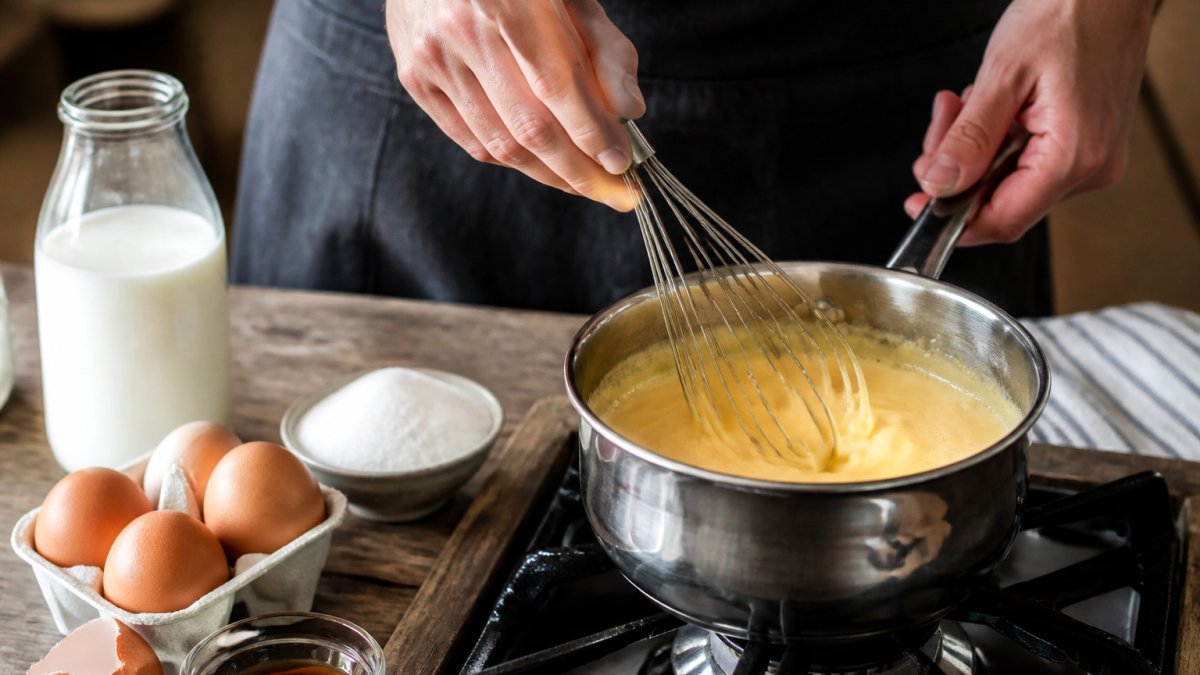
The effort level is moderate. You need to pay attention so the eggs don’t scramble and the custard doesn’t break.
Homemade custard tastes better because it’s fresh. You’re not paying for packaging, shipping, or preservatives, just ingredients and your time.
The risk is real: overheating scrambles the eggs and creates lumps, and not whisking enough while adding hot milk cooks the eggs unevenly.
Most people find the second batch easier, and by the third it becomes routine.
Choosing between homemade custard and grocery store custard depends on what matters most to you.
Frequently Asked Questions
Does homemade custard taste better than grocery-store custard?
Homemade custard typically has a richer, more complex flavor because it uses fresh eggs, real milk, and vanilla. Store-bought custard often relies on flavor extracts and additives to achieve sweetness and vanilla notes, which can taste flatter by comparison. The difference is noticeable to most people, especially in side-by-side tastings, but some prefer the consistency of store-bought versions. Fresh homemade custard also develops deeper flavor notes as it cools.
How long does homemade custard last in the refrigerator?
Properly stored homemade custard stays fresh for 3 to 4 days in the refrigerator when kept in an airtight container. The shelf life depends on how quickly it cools after cooking and how clean your storage containers are. Always cover the surface with plastic wrap or a lid to prevent a skin from forming and to block air exposure. If you notice any off smell or unusual texture, discard it. Homemade custard does not contain preservatives, so it spoils faster than store-bought versions.
What is the main difference between homemade custard and store-bought custard?
The biggest difference is ingredient simplicity and freshness. Homemade custard uses milk, eggs, sugar, and vanilla, nothing else. Store-bought custard often contains cornstarch or custard powder, modified starches, emulsifiers, and preservatives to extend shelf life and ensure consistent texture. Homemade custard must be eaten within days; store-bought lasts weeks or months. Homemade also requires cooking time and attention, while store-bought is instant convenience.
Can you use store-bought custard in desserts like tarts and pastries?
Yes, store-bought custard works well in tarts, pastries, and other desserts. Its thicker, more stable texture (thanks to cornstarch or custard powder) actually makes it easier to handle in baking than fresh homemade custard. However, the flavor will be less rich. You can improve store-bought custard by adding a splash of vanilla extract, a pinch of nutmeg, or fresh whipped cream on top. Some bakers thicken it further with a small amount of gelatin or cornflour to match the body of homemade versions.
Leave a Reply